How to Cook With TVP (Textured Vegetable Protein)

 Jump to recipe ↓
 In this guide8
The first time I cooked TVP I did everything wrong and nearly threw the bag out. I poured the dry beige flakes into a bowl, covered them with tap water because the package said to, drained them, and dumped the soggy result into a pan of tomato sauce.
It tasted like wet packing material. I remember standing over the pot thinking people genuinely eat this on purpose? It sat in my cupboard for two months after that, judged and ignored.
What changed everything was a single swap I read on the back of a different brand's bag: hydrate it in seasoned broth, not water. That is the whole secret, and it is the reason this guide exists.
TVP, textured vegetable protein, is essentially a flavorless dry sponge made from soy. Whatever you soak it in is the flavor it keeps. Soak it in plain water and you get bland sponge.
Soak it in hot savory broth and you get something that browns up into the cheapest, most convincing ground-meat crumble in the vegan kitchen. Let me walk you through exactly how I do it now.
What TVP actually is
TVP is defatted soy flour. The oil gets pressed out of soybeans (that is what makes soybean oil), and the protein-rich flour left behind is cooked under pressure, extruded into shapes, and dried. The result is shelf-stable, almost pure protein, and bone dry.
Bob's Red Mill sells it in the baking aisle, Anthony's sells big bags online, and your bulk-bin store probably has it cheaper still. You will also see it labeled TSP (textured soy protein) or soy curls, though soy curls are a slightly different whole-soybean product with a chewier bite.
It comes in two forms that matter for cooking, and I will get to the granule-versus-chunk question below. The nutrition is the headline: a quarter cup of the dry granules carries around 12 grams of protein and roughly 80 calories with almost no fat.
It is one of the most efficient protein sources a plant eater can keep on a shelf. If you want the bigger picture on hitting your numbers, I wrote a whole piece on getting enough protein on a vegan diet that puts TVP in context next to lentils, tofu, and tempeh.
The rehydration ratio that actually works
 Photo: Alesia Kozik / Pexels
Here is the part everyone overcomplicates. The working ratio is close to one-to-one by volume: about 1 cup of dry TVP granules to 7/8 cup of hot liquid. By weight that lands near 1 part TVP to 2 parts liquid, because the dry stuff is feather-light.
I always start with slightly less liquid than I think I need, because you can add a splash but you cannot take it back out, and waterlogged TVP browns badly.
My actual method: I put the dry TVP in a heatproof bowl, pour boiling broth over it until it is just covered, give it one stir, and walk away for 8 to 10 minutes. It drinks the liquid fast in the first two minutes, then keeps softening.
When the time is up I pinch a crumble; if the center is still firm and dry, I add another two tablespoons of hot broth and wait another few minutes. Then, and this matters, I drain off any liquid that did not get absorbed and press the TVP gently against the strainer.
Excess water is the enemy of a good brown crust.
Why broth, never plain water
I want to hammer this because it is the one thing that turns TVP from a punchline into a staple. TVP has no meaningful flavor of its own. None.
There is no fat carrying taste, no fibers with their own character. The soaking liquid is the entire flavor profile of the inside of every crumble, which is exactly how a marinade works on tofu.
So I never soak in water. My default soaking liquid is hot vegetable broth plus a tablespoon of soy sauce or tamari per cup of TVP, and often a teaspoon of tomato paste stirred in for umami and color.
If I am out of boxed broth, I use water plus a heaped teaspoon of nutritional yeast, a splash of soy sauce, and a little onion powder, which fakes a savory broth convincingly. The soy sauce does double duty here as salt and as deep savory backbone.
You can taste the difference in the first bite: broth-soaked TVP tastes seasoned all the way through, while water-soaked TVP is only ever seasoned on the surface by your sauce.
Granule versus chunk: pick by the dish
 Photo: Novkov Visuals / Pexels
The two formats are not interchangeable, and using the wrong one is a quiet reason a lot of people decide they hate TVP.
Granules and small flakes are the ground-meat format. They rehydrate in minutes and brown into crumbles the exact size of cooked ground beef. This is what you want for tacos, chili, bolognese, sloppy joes, and any meat sauce.
It is by far the more useful form for everyday cooking, and it is what I assume for the rest of this guide.
Chunks are thumbnail-sized pieces meant to mimic stew meat or chicken. They take longer to hydrate, usually 15 to 20 minutes in simmering broth, and they shine in curries, stews, and stir-fries where you want a chewy bite to hold a sauce.
They are wonderful in a coconut curry but completely wrong for taco meat, where they would feel like rubbery surprises. If a recipe just says TVP, it almost always means granules. Buy a bag of each if you can; they live forever in the pantry.
Taco meat, chili, and bolognese
Once your TVP is hydrated in seasoned broth and drained, the cooking is the same easy move every time: brown it hard, then build the dish around it. Heat a tablespoon of neutral oil in a wide skillet until it shimmers, add the drained TVP in a single layer, and let it sit undisturbed for a couple of minutes before stirring.
You want the crumbles to catch color and crisp at the edges. This dry-frying step is what gives TVP chew and a meaty crust instead of a mushy texture, and skipping it is the second most common mistake after the water soak.
For taco meat, I brown the TVP with a finely diced onion, then add 2 teaspoons each of cumin and chili powder, a teaspoon of smoked paprika, a clove of minced garlic, and a tablespoon of tomato paste. A splash of broth deglazes the pan and pulls it together.
Pile it into warm tortillas. It is honestly hard to tell from a seasoned beef crumble, and it costs a fraction as much. If you want a version with a chewier base, my vegan ground beef guide compares TVP against a walnut-lentil mince side by side.
For chili, I do not even brown the TVP separately. I build the chili base with onions, garlic, peppers, and spices, add the tomatoes and beans, then stir the rehydrated TVP straight in and let it simmer 20 minutes.
It soaks up the chili liquid and disappears into the pot as texture and protein. About 1 cup of dry TVP bulks up a pot of bean chili beautifully without anyone clocking it.
For bolognese, I treat TVP as half the mince and finely chopped mushrooms or walnuts as the other half. The mushrooms add the meaty, glutamate-rich depth that pure soy lacks, and the TVP adds bulk and protein.
I brown them together, add tomato paste and crushed tomatoes, and let it cook low for at least 30 minutes. A spoonful of vegan parmesan on top and you would not guess it started as dry flakes.
The flavor secret across all three: TVP loves acid and salt at the end. A squeeze of lime on the tacos, a splash of soy sauce in the bolognese. Because the soy itself is mild, these brightening notes do a lot of work.
The cheap protein math
This is the part that made TVP permanent in my kitchen. A typical bag of TVP runs about four to six dollars for a pound of the dry stuff.
A pound of dry TVP rehydrates into roughly three to four pounds of cooked crumble, because it triples in weight once it drinks up the broth. So you are paying somewhere around a dollar fifty per cooked pound.
Now the protein. That same pound of dry TVP holds on the order of 200 grams of protein. Compare that to a package of Beyond or Impossible at six to eight dollars for a single pound that yields one pound cooked.
TVP is not just a little cheaper; it is several times cheaper per gram of protein than any packaged plant meat, and meaningfully cheaper than canned beans per gram of protein too. According to the Vegan Society's protein guidance, soy is one of the few plant foods with a complete amino acid profile, so you are not trading cost for quality here.
For anyone feeding a family or just protecting a grocery budget, this is the single highest-leverage staple I stock. I put it near the top of my vegan pantry stocking guide for exactly this reason.
Storage, and how to never cook it twice
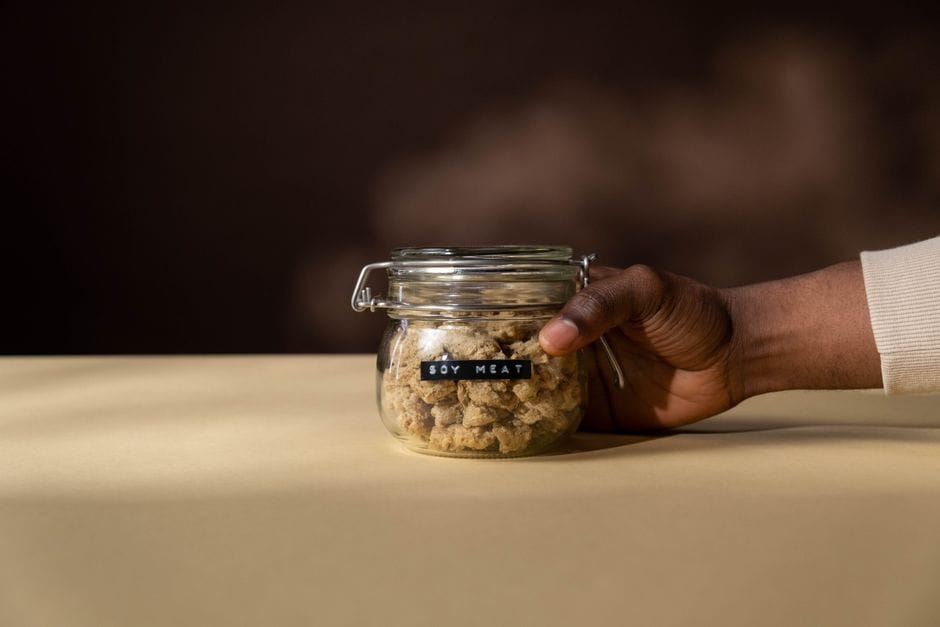
Dry TVP is the easiest thing in your kitchen to store. Kept in a sealed jar in a cool, dark cupboard, it stays good for a year or more. I decant a fresh bag into a quart mason jar so I can see when I am running low.
Keep it away from humidity, since it is a sponge and will happily absorb moisture from a steamy kitchen.
Once rehydrated and cooked, treat it exactly like cooked ground meat. It keeps about four days in the fridge in a sealed container.
Better yet, it freezes beautifully: I cook the whole bag's worth of seasoned taco crumble at once, cool it, and press it flat into freezer bags in meal-sized portions. It keeps two to three months frozen and reheats straight from the bag in a hot dry skillet in a few minutes, crisping right back up.
A flat brick of seasoned TVP in the freezer is the reason a chaotic weeknight still ends in tacos here.
One honest failure note from my own freezer: do not freeze TVP that you soaked but never browned. The unbrowned, waterlogged crumbles turn weirdly spongy and pale after thawing. Always brown it before it goes cold, then freeze.
The crust survives the freezer; raw mush does not.
Is your TVP definitely vegan?
Plain TVP is just soy, so it is reliably vegan. The thing to actually check is flavored or pre-seasoned TVP and the soy "beef" or "chicken" crumbles sold in some shops, which occasionally sneak in milk powder, egg, or a non-vegan natural flavor.
The other quiet catch is the broth you rehydrate it in: plenty of supermarket "vegetable" bouillon and gravy granules contain milk solids or are not vegan, so the soak can sabotage an otherwise plant-based dish. When a label is vague, I run the product through our vegan ingredient checker rather than guess, and I keep the Is It Vegan database open for the bouillon brands.
Two seconds of checking beats a ruined batch.
Here is the practical takeaway, the thing I wish someone had told me before I wasted that first bag: TVP is not the problem, the water is. Soak it in hot seasoned broth, drain it, brown it hard, and finish with a little acid and salt.
Do that and you have a complete-protein, year-stable, dirt-cheap ground-meat crumble that disappears into tacos, chili, and bolognese without anyone at the table knowing it started as a bag of dry beige flakes. Buy the granules first, keep a jar on the shelf, and you will reach for it more than you expect.
The recipe
TVP Taco Meat
Prep
10 min
Cook
12 min
Makes
4 servings
Ingredients
- 1 cup dry TVP granules
- 7/8 to 1 cup hot vegetable broth (for soaking), plus a splash for deglazing
- 1 tablespoon soy sauce or tamari
- 1 teaspoon tomato paste (stirred into soaking broth)
- 1 tablespoon neutral oil
- 1 small onion, finely diced
- 2 teaspoons ground cumin
- 2 teaspoons chili powder
- 1 teaspoon smoked paprika
- 1 clove garlic, minced
- 1 tablespoon tomato paste (added during cooking)
Instructions
- 1 Combine the dry TVP granules, soy sauce or tamari, and 1 teaspoon tomato paste in a heatproof bowl. Pour the hot vegetable broth over the TVP until just covered, give it one stir, and let it sit undisturbed for 8 to 10 minutes.
- 2 After 8 to 10 minutes, pinch a crumble to check the center. If it is still firm and dry, add 2 more tablespoons of hot broth and wait another few minutes.
- 3 Drain the rehydrated TVP in a strainer and press it gently to remove excess liquid. Removing excess moisture is essential for browning.
- 4 Heat 1 tablespoon of neutral oil in a wide skillet over medium-high heat until it shimmers. Add the drained TVP in a single layer and let it sit undisturbed for 2 minutes so the crumbles develop a crust.
- 5 Add the finely diced onion and stir, cooking for another 2 to 3 minutes until the onion softens and the TVP is browned at the edges.
- 6 Add the minced garlic, cumin, chili powder, smoked paprika, and 1 tablespoon of tomato paste. Stir to coat the crumbles in the spices and cook for 1 minute.
- 7 Add a splash of vegetable broth to deglaze the pan, scraping up any browned bits. Stir until the liquid is absorbed and the mixture is cohesive.
- 8 Taste and adjust salt. Pile into warm tortillas and finish with a squeeze of lime.
Notes
- ·Use granule or small-flake TVP, not chunks. Chunks are for stews and curries, not taco meat.
- ·Start with slightly less soaking liquid than you think you need. Waterlogged TVP browns poorly.
- ·If you are out of boxed broth, substitute hot water plus 1 heaped teaspoon nutritional yeast, a splash of soy sauce, and a pinch of onion powder.
- ·The dry-frying step (letting the TVP sit undisturbed in a hot pan) is critical for chew and a meaty crust. Do not skip it.
- ·Cooked TVP taco meat keeps 4 days in the fridge or 2 to 3 months in the freezer. Brown it before freezing (never freeze unbrowned, waterlogged crumbles).
Calories
120 per serving (based on 1/4 cup dry TVP per serving)
Protein
12g
Fat
4g
Carbs
7g
Frequently asked questions
What is the rehydration ratio for TVP?+
Use roughly equal volumes of dry TVP and hot liquid, about 1 cup of dry granules to 7/8 to 1 cup of hot broth. Start with a touch less liquid than you think, let it sit 8 to 10 minutes, and add a splash more only if the crumbles still feel dry in the center. By weight it works out to roughly 1 part TVP to 2 parts liquid, since the dry stuff is so light. Drain any extra before you brown it so the pan stays hot.
Why rehydrate TVP in broth instead of water?+
TVP has almost no flavor of its own, so whatever liquid you soak it in is the only flavor that gets inside each crumble. Plain water gives you damp, bland sponge. Hot vegetable broth with a splash of soy sauce seasons it all the way through, the way a marinade would, so it tastes savory before it ever hits the pan. This single change is the difference between TVP that reads as meat and TVP that reads as cardboard.
Is TVP healthy?+
TVP is just defatted soy flour that has been cooked, extruded, and dried, so it is genuinely high in protein and fiber with almost no fat. A quarter cup of the dry granules has around 12 grams of protein and only about 80 calories. It is a minimally processed whole-soy product, not a fake-meat patty, so it does not carry the saturated coconut oil or high sodium of packaged burgers. The main thing to watch is the salt you add yourself through broth and soy sauce.
How long does TVP last?+
Dry TVP keeps for a year or more in a sealed jar in a cool, dark cupboard, which is why I treat it as a pantry staple rather than a fresh ingredient. Once you rehydrate it, treat it like cooked meat: it lasts about 4 days in the fridge and freezes well for 2 to 3 months. I almost always cook the full bag's worth, then freeze it flat in bags so a taco night is ten minutes away.
Written by
VeganDigest Editorial is the small independent team that researches and fact-checks this site. We are not doctors or dietitians. For every is-it-vegan verdict we read the product's current ingredient list and manufacturer information, and for anything health-related we report guidance from recognized bodies such as the NHS, the Vegan Society, and the Academy of Nutrition and Dietetics rather than offering medical advice. Every page shows the date it was last verified, and our full process is on the How We Verify page.
Comments