How to Cook Edamame (Boiled, Steamed, Pan-Seared)

 Jump to recipe ↓
 In this guide8
The first time I ordered edamame at a restaurant, I was maybe nineteen and I did not know you were supposed to spit out the pods. I bit into the first one whole, hit that papery, stringy shell, and chewed through it with a straight face because I was too embarrassed to ask.
It was awful. I assumed for about a year afterward that I just did not like edamame, when really I had been eating the one part you are meant to throw away.
So let me save you that. Edamame is one of the easiest, fastest, most rewarding things you can cook, and it took me an embarrassingly long time to realize that the cooking part is almost trivial. The bag does most of the work before you ever open it.
What actually matters is how you finish it: the salt, the timing, and the two or three minutes that separate bright, snappy beans from sad grey mush. This is everything I have learned from making it a couple of times a week.
Fresh versus frozen, and why frozen wins
Let me get the honest part out of the way first. You are almost certainly going to use frozen edamame, and that is the right call.
Fresh, in-pod soybeans on the stem are a beautiful thing, but in most Western markets they are genuinely hard to find. I have seen them maybe a handful of times, at a farmers market in late summer and once at a Japanese grocery.
The rest of the year, fresh edamame simply is not on the shelves where I live. Frozen is what you will actually be cooking, and the good news is that frozen edamame is excellent.
Here is the thing nobody tells you: frozen edamame is already blanched before it is frozen. The beans are picked young, plunged into boiling water to set their color and stop them spoiling, then frozen fast.
That means when you cook it at home, you are not cooking raw beans. You are reheating beans that are already most of the way done. This single fact explains every cooking time in this guide and every mistake I made early on.
I buy whatever is in the freezer aisle. Trader Joe's keeps both in-pod and shelled, Whole Foods 365 has a reliable bag, and most large supermarkets stock a generic version near the frozen peas. They are all roughly the same.
One quick habit worth keeping: if you ever pick up a flavored or pre-seasoned frozen bag, or a bottled dipping sauce to go with it, glance at the label. Most plain edamame is just soybeans, but seasoned blends can hide fish-derived bonito or other surprises.
I run anything questionable through the vegan ingredient checker or look the brand up in the Is It Vegan database before it goes in the pot.
In-pod versus shelled: which to buy
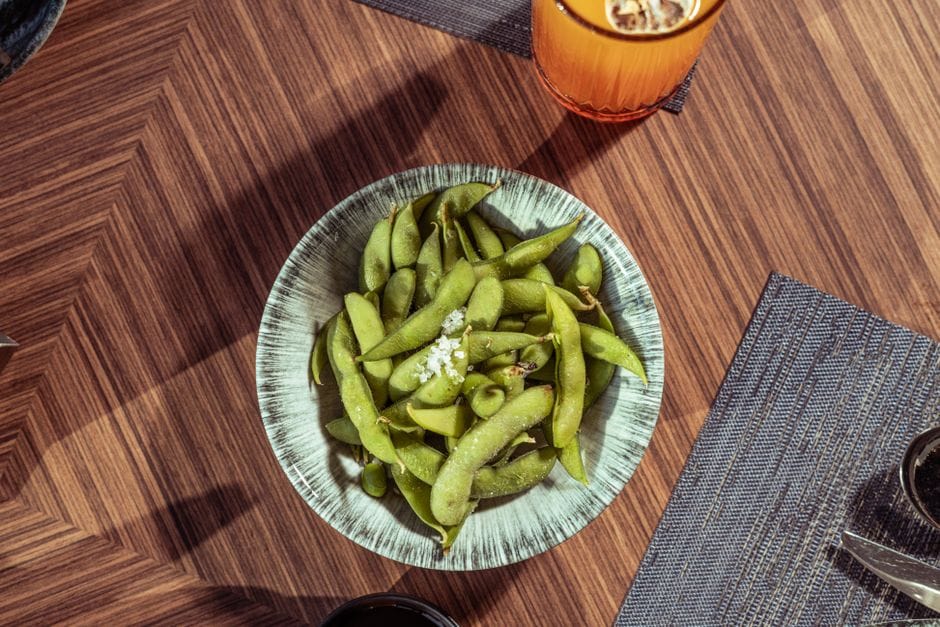 Photo: khezez | خزاز / Pexels
You will see two kinds in the freezer, and they are for two different jobs.
In-pod edamame is the snacking format. The beans stay inside their fuzzy green shells, and you cook the whole pod, salt the outside, and squeeze the beans out with your teeth at the table.
This is the version you get at restaurants, and it is the one I reach for when I want something to pick at while dinner finishes cooking. The pods make it slow and social, which is part of the appeal.
Shelled edamame, sometimes labeled mukimame, is just the loose beans with the pods already removed. This is what you want for cooking edamame into things: tossing through a grain bowl, blistering in a pan, folding into a salad, blending into a dip.
No fishing the beans out, no pile of empty shells. I keep both bags in my freezer at all times, because they genuinely do different things.
If you only buy one, buy shelled. It is more versatile, and you can always eat shelled beans as a snack even if you lose the theater of the pods.
How to boil edamame
Boiling is the classic method and the one I use most for in-pod snacking. It is fast and forgiving as long as you respect how little time it needs.
Bring a pot of water to a rolling boil and salt it well, the way you would for pasta. I use a generous tablespoon of salt for a few cups of water. Tip the frozen edamame straight in, no thawing.
For in-pod, boil 4 to 6 minutes. For shelled beans, 3 to 5 minutes is plenty. You are looking for the beans to turn a deeper, brighter green and to taste tender but still with a clean snap when you bite one.
Then drain immediately. This is the step people skip and regret. Edamame keeps cooking in its own heat, and the longer it sits in hot water the closer it slides toward mushy.
I drain into a colander and give it a quick shake. If I am not eating it right away, or if I want it for a cold salad, I run cold water over it for a few seconds to stop the cooking dead and lock in the color.
The honest failure note: the first dozen times I boiled edamame, I treated it like dried beans and walked away for ten minutes. The result was olive-grey, soft, and flavorless, the beans collapsing instead of popping.
Because the edamame is pre-blanched, ten minutes is roughly twice as long as it needs. Set a timer for four minutes and taste one. You can always give it another minute.
You cannot un-mush it.
How to steam edamame
 Photo: Change C.C / Pexels
Steaming is my quiet preference, and the method I would push you toward if you want the best flavor. Boiling leaches a little of the sweet, beany taste into the water. Steaming keeps all of it in the bean.
Set a steamer basket over an inch or two of boiling water, tip in the frozen edamame, put the lid on, and steam for 5 to 7 minutes. It takes a minute or two longer than boiling because steam is gentler than a rolling boil, but the trade-off is beans that taste more of themselves.
No salty cooking water means the salt all goes on at the end, exactly where you taste it.
No steamer basket? A metal colander balanced over a pot works, or a heatproof plate on a couple of balls of foil.
You can also steam edamame in the microwave: put the frozen beans in a bowl with a splash of water, cover with a plate, and microwave for 3 to 5 minutes, stopping to stir halfway. It is not elegant, but on a weeknight when I want shelled edamame to throw into a bowl, the microwave is genuinely the route I take most often.
However you steam it, the doneness cue is the same. The beans should be hot all the way through, brighter green than they went in, and tender with a slight resistance. Taste one.
Steam another minute if it needs it.
Salting: the detail beginners miss
This is the part that separates restaurant edamame from the limp version, and it is so simple it feels like cheating.
Salt the pods on the outside, after cooking, with flaky salt. Not fine table salt buried in the boiling water, but coarse flakes scattered over the drained, still-damp pods. The reason is mechanical: you do not eat the pod.
You squeeze the bean out with your teeth, and as it slides past your lips the salt on the outside of the pod hits your mouth directly. That burst of salt against the sweet warm bean is the entire experience.
Salt only the water and the beans inside taste flat, because the salt never quite penetrates the pod.
I use Maldon or a coarse sea salt. Toss the hot pods with a good pinch while they are still damp so the flakes cling, and that is it. For shelled beans, where there is no pod to coat, salt them directly after draining and toss so every bean gets some.
One small thing I do: a squeeze of lime over the salted pods. The acid lifts the whole thing and makes the beans taste even more vivid. It is not traditional, but it is very good.
How to pan-sear edamame, plus garlic-chili
Pan-searing is where edamame stops being a side and becomes the thing you actually want to eat. The blistering adds a smoky, charred edge you cannot get from water, and the beans take on a wrinkled, caramelized skin. This is best with in-pod edamame, where the charred pod perfumes everything.
Start with thawed or par-cooked edamame so it is not icy. Get a heavy skillet, cast iron is ideal, properly hot over medium-high heat with a tablespoon of a neutral oil or sesame oil.
Add the edamame in a single layer and let it sit, mostly undisturbed, for 3 to 4 minutes until you see brown blistered spots, then toss and char the other side for another couple of minutes. You want some genuine color and a little char on the pods.
Now the garlic-chili finish, which is the version I make constantly. Push the edamame to one side, drop in two cloves of finely minced garlic and a good pinch of chili flakes or a spoonful of chili crisp, and let them sizzle in the oil for thirty seconds until fragrant.
Watch the garlic, because it goes from golden to burnt in seconds. Then toss everything together, splash in a tablespoon of soy sauce so it hisses and coats the pods, and finish with a teaspoon of rice vinegar and a final scatter of flaky salt and toasted sesame seeds.
The soy sauce caramelizes on the hot pods almost instantly. A squeeze of lime at the end makes it sing.
A quick note for anyone reading older recipes: classic izakaya-style edamame sometimes calls for mirin or sake. I leave both out entirely and lean on sesame oil, garlic, chili, soy sauce, and rice vinegar instead. You lose nothing.
The garlic-chili version above is, if anything, punchier.
The protein angle, and why I eat it constantly
Here is the real reason edamame earns a permanent spot in my freezer. A cooked cup delivers roughly 17 to 18 grams of protein, which is a genuinely large number for something you eat by the handful. Most snack foods give you a gram or two.
Edamame gives you nearly as much as a couple of eggs.
What makes it stand out is that edamame, being young soybeans, is a complete protein. It contains all nine of the essential amino acids your body cannot make on its own, which most single plant foods do not.
The Vegan Society notes that eating a variety of protein sources covers your amino acid needs easily, and soy foods like edamame do a lot of that heavy lifting on their own. If you want the bigger picture, my guide to vegan protein sources lays out how it stacks up against beans, lentils, and seitan.
This is why I treat shelled edamame as a building block, not a snack. I stir a handful into grain bowls for an easy protein bump, scatter it over salads, fold it through fried rice, and blend it into a bright green dip.
It pairs beautifully with crisp pan-fried tofu or with the chewy bite of tempeh in the same bowl, giving you two complementary plant proteins in one meal. A bag of frozen shelled edamame is one of the cheapest, fastest ways I know to make a thrown-together bowl actually filling.
Putting it all together
Edamame rewards you almost out of proportion to the effort. For snacking, boil or steam in-pod for four to six minutes, drain hard, salt the outside with flaky salt, and squeeze the beans straight into your mouth.
For everything else, keep shelled beans in the freezer and treat them as a protein you can throw at any bowl, salad, or stir-fry in five minutes flat. When you want it to feel special, blister it in a hot pan with garlic, chili, and soy.
If you want more freezer-to-plate staples like this, the tofu cooking guide and the rest of the protein-focused how-tos are where I would head next. But honestly, start tonight.
Boil a bag of in-pod edamame, scatter flaky salt over the wet pods, and eat the first one the moment it is cool enough to handle. Just remember to spit out the shell.
The recipe
Garlic-Chili Pan-Seared Edamame
Prep
5 min
Cook
10 min
Makes
2 servings
Ingredients
- 2 cups frozen in-pod edamame, thawed or par-cooked
- 1 tablespoon neutral oil or sesame oil
- 2 cloves garlic, finely minced
- 1 good pinch chili flakes, or 1 spoonful chili crisp
- 1 tablespoon soy sauce
- 1 teaspoon rice vinegar
- Flaky sea salt, to finish
- Toasted sesame seeds, to finish
- Squeeze of lime (optional)
Instructions
- 1 Thaw or par-cook the edamame so it is not icy going into the pan.
- 2 Heat a heavy skillet (cast iron is ideal) over medium-high heat until properly hot. Add the oil.
- 3 Add the edamame in a single layer. Let it sit mostly undisturbed for 3 to 4 minutes until brown blistered spots appear.
- 4 Toss and char the other side for another 2 minutes. You want genuine color and a little char on the pods.
- 5 Push the edamame to one side of the pan. Add the minced garlic and chili flakes (or chili crisp) to the empty side and let them sizzle in the oil for 30 seconds until fragrant. Watch the garlic closely so it does not burn.
- 6 Toss everything together. Splash in the soy sauce so it hisses and coats the pods.
- 7 Add the rice vinegar and toss again.
- 8 Finish with a scatter of flaky salt and toasted sesame seeds. Squeeze lime over the top if using.
- 9 Serve immediately.
Notes
- ·The article recommends cast iron for the best char.
- ·Classic versions sometimes use mirin or sake; the author leaves both out and uses sesame oil, garlic, chili, soy sauce, and rice vinegar instead.
- ·For plain boiled edamame: boil salted water, add frozen edamame straight from frozen, cook in-pod 4 to 6 minutes or shelled 3 to 5 minutes, drain immediately, and salt the outside of the pods with flaky salt while still damp.
- ·For steamed edamame: steam over boiling water for 5 to 7 minutes, or microwave in a covered bowl with a splash of water for 3 to 5 minutes, stirring halfway.
- ·Do not eat the pod. Squeeze the beans out with your teeth and discard the shell.
- ·A cooked cup of edamame provides roughly 17 to 18 grams of complete protein.
Calories
160 per serving (estimate)
Protein
17g
Fat
7g
Carbs
14g
Frequently asked questions
How long do you cook edamame?+
Frozen in-pod edamame needs about 4 to 6 minutes in boiling water, and shelled beans about 3 to 5 minutes. Steaming takes a touch longer, around 5 to 7 minutes. Because almost all the edamame you buy is already blanched before freezing, you are really just heating it through, so err on the short side and taste one early.
Do you eat the edamame pod?+
No, the pod is fibrous and tough and is not meant to be eaten. You hold the salted pod to your lips, squeeze the beans straight into your mouth with your teeth, and set the empty shell aside. The salt on the outside of the pod is the whole point, since it hits your lips as the beans slide out.
Is edamame a good source of protein?+
Yes, and an unusually good one. A cooked cup gives you roughly 17 to 18 grams of protein, and because edamame is young soybeans it is a complete protein, meaning it contains all nine essential amino acids. That puts it ahead of most snack foods and makes it an easy way to add protein to bowls and salads.
Can you cook edamame from frozen without thawing?+
Yes, and you should. Drop frozen edamame straight into boiling water or a steamer basket with no thawing at all. Thawing first just makes the beans waterlogged and mushy once they hit the heat. Frozen to plate is genuinely the best route, and it is faster too.
Written by
VeganDigest Editorial is the small independent team that researches and fact-checks this site. We are not doctors or dietitians. For every is-it-vegan verdict we read the product's current ingredient list and manufacturer information, and for anything health-related we report guidance from recognized bodies such as the NHS, the Vegan Society, and the Academy of Nutrition and Dietetics rather than offering medical advice. Every page shows the date it was last verified, and our full process is on the How We Verify page.

Comments