How to Get B12 on a Vegan Diet (What You Actually Need)
In this guide8
- 01Why B12 is the one you can't wing
- 02What B12 actually does in your body
- 03The pseudo-B12 trap that fooled me
- 04Fortified foods: a real option if you're consistent
- 05Supplements: the simplest, most reliable route
- 06Deficiency: the slow leak you won't feel
- 07How B12 fits with iron and calcium
- 08The bottom line
I went almost two years as a vegan without taking a single B12 supplement, and I was quietly proud of it. I ate well, I felt fine, and I had convinced myself that all the nutritional yeast I was shaking onto everything had me covered.
"The only reliable vegan sources of B12 are foods fortified with B12 (including some plant milks, some soy products and some breakfast cereals) and B12 supplements."
Source: The Vegan Society
Then a routine blood test came back with my B12 sitting at the very bottom of the normal range, the kind of number where the doctor circles it and asks a pointed question. I was not deficient yet.
But I was coasting toward it, feeling great the whole way, which is exactly what makes this nutrient sneaky.
So let me be direct, because this is the one place I will not soften anything. B12 is the single nutrient on a vegan diet that you genuinely, non-negotiably have to think about. Protein takes care of itself.
Iron and calcium need a little attention but live in plenty of plant foods. B12 is different, and pretending otherwise is the one piece of vegan advice that can actually hurt you.
Why B12 is the one you can't wing
Here is the fact that reframes everything: B12 is not made by plants, and it is not made by animals either. It is made by bacteria.
Animals get their B12 because those bacteria live in their gut and their environment, or because the animal eats other animals that accumulated it. The vitamin works its way up the food chain, but it starts with microbes in soil and water.
Plants have no need for B12 and no way to make it, so they contain essentially none. That is not a flaw in plants and it is not a flaw in a vegan diet. It is just chemistry.
In a modern world of clean produce and treated water, none of us, vegan or not, are picking up meaningful B12 from bacteria in the dirt anymore. Animal products are simply the usual delivery vehicle, and once you remove them, you need another reliable source on purpose.
This is why "but humans evolved eating plants" or "B12 is in the soil" arguments fall apart in practice. The amounts and the reliability are not there.
The honest position, and the one held by every major health body I trust, is that vegans need B12 from fortified foods or a supplement. The Vegan Society says this plainly, and so do the NHS, the NIH, and the Academy of Nutrition and Dietetics.
When the vegan advocacy organizations and the government health agencies agree, the matter is settled.
What B12 actually does in your body
 Photo: Tima Miroshnichenko / Pexels
It helps to know why this nutrient is worth the fuss, because "take a pill" lands harder when you understand the stakes. B12 does two big jobs. It is essential for making healthy red blood cells, and it is essential for keeping your nervous system and the protective myelin sheath around your nerves intact.
When B12 runs low, both systems start to fray. The blood side shows up as a specific kind of anemia that leaves you tired and short of breath.
The nerve side is the scarier one, because it can show up as tingling, numbness, balance problems, and memory or mood issues. The nerve damage from a long, deep deficiency can become permanent. This is not a "you might feel a bit run down" nutrient.
It is a structural one.
That is the whole reason I refuse to hedge here. With most things in nutrition I am relaxed and tell people not to obsess. With B12 I will happily be the nag.
The pseudo-B12 trap that fooled me
Let me save you from the exact mistake I made. There is a long list of plant foods that get passed around as "natural vegan B12 sources," and almost all of them are a trap.
Spirulina, chlorella, most seaweed and nori, mushrooms, and fermented foods like tempeh and miso are frequently cited. The problem is that what they contain is largely pseudo-B12, inactive analogues that look like B12 on some tests but that your body cannot actually use.
Worse, these analogues can compete with real B12 and can muddy a blood test, making your numbers look better than your true status. So leaning on spirulina is not just useless, it can give you false confidence.
I had been treating my nutritional yeast like a B12 source for two years, which brings me to the most important label-reading lesson in this whole article.
Nutritional yeast only contains B12 if it has been specifically fortified with it. Plain nooch does not naturally carry meaningful B12. Some brands, like Bragg and certain Red Star products, are fortified and will list a clear B12 figure on the panel.
Others are not fortified at all. The fix is simple: read the nutrition label and look for an actual B12 number. If you love nooch as much as I do, our nutritional yeast guide covers which kinds are fortified and how to use it.
And if you are ever unsure whether a packaged product is fortified or even vegan, run it through our ingredient checker before you trust it.
Fortified foods: a real option if you're consistent
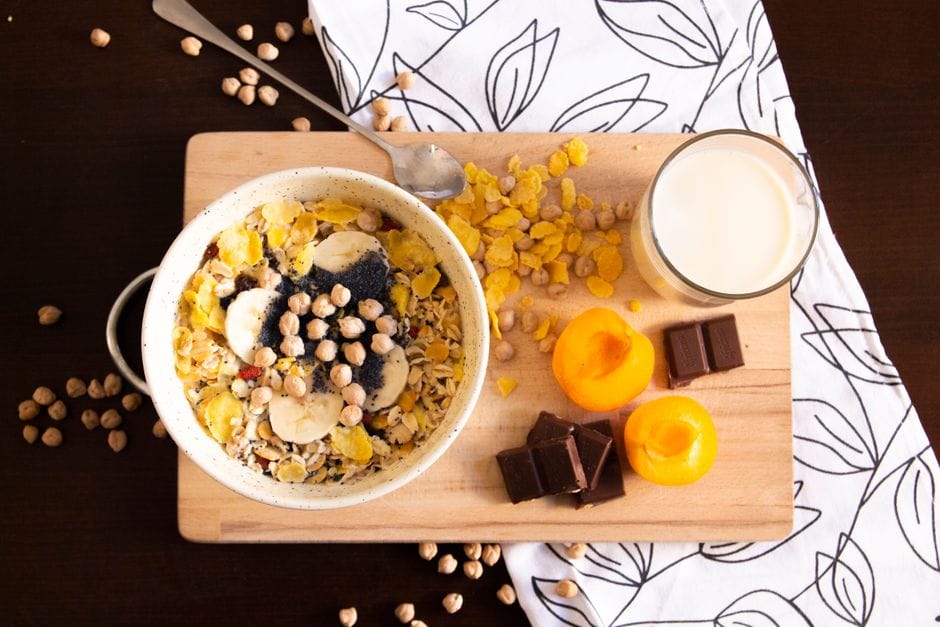 Photo: Paul Seling / Pexels
Fortified foods are a legitimate way to get B12, and for people who dislike the idea of a daily pill, they can do the whole job. The catch is consistency.
Because of how absorption works, you need B12 spread across the day in small hits rather than one big serving, which means you have to actually eat fortified foods two or three times a day, every day.
The most common fortified foods are some plant milks, some soy products, some breakfast cereals, and certain brands of nutritional yeast. Notice the word "some" doing heavy lifting there.
Fortification is not universal. Two cartons of soy milk sitting side by side on the shelf can differ, with one fortified with B12 and one not. So this strategy lives or dies on reading labels.
To make fortified foods your primary source, the Vegan Society guidance is to eat them two or three times a day so that you take in at least 3 micrograms of B12 across the day. In practice that might look like fortified cereal with fortified plant milk at breakfast, a sandwich with a fortified spread or a B12-fortified product at lunch, and fortified nooch on your dinner.
It works, but you have to mean it. The day you skip, you skip your B12, and a few stray days here and there is how a slow shortfall creeps in.
For most people I think a supplement is simply easier insurance, but fortified foods are a perfectly valid route if you are diligent.
Supplements: the simplest, most reliable route
This is what I do now, and what I recommend to anyone who asks: take a supplement and stop thinking about it. It is cheap, it is reliable, and it removes the daily label-reading burden entirely. But the dosing confuses people, so let me explain the part that actually matters.
Your body only needs a tiny amount of B12. The UK figure cited by the Vegan Society is about 1.5 micrograms a day, and the US RDA from the NIH is 2.4 micrograms a day for adults.
So why do supplements come in doses of 10, 100, 500, or 1000 micrograms, numbers that look absurdly large next to that? Because of how absorption works. B12 is actively absorbed through a mechanism that saturates at roughly 1.5 to 2 micrograms per dose.
Anything beyond that only gets picked up by slow passive absorption at a rate of around 1 percent. So a large single dose is mostly not absorbed, and the dose is deliberately high to make sure enough sneaks through.
That mechanism is exactly why the recommended routines look the way they do. The Vegan Society gives three clear options, and you only need to follow one:
- Eat fortified foods two or three times a day, totaling at least 3 micrograms daily.
- Take a daily supplement providing at least 10 micrograms.
- Take a weekly supplement providing at least 2000 micrograms.
The less often you dose, the higher the amount has to be, because you are relying more on that inefficient passive absorption. A daily 10 microgram tablet and a once-weekly 2000 microgram tablet both work; pick whichever you will actually remember.
I keep a bottle of cyanocobalamin tablets by my coffee maker so I see it every morning. Cyanocobalamin is the cheapest, most stable, and best-studied form, and it is the sensible default for most people. There is no benefit to the boutique forms for the average healthy vegan.
This is not just my read. Registered dietitian Jack Norris, who runs the evidence-based resource VeganHealth.org, is firm that vegans should get their B12 from a supplement or from reliably fortified foods rather than trying to wing it from anything unfortified, and he points to cyanocobalamin as the form to default to because it is the most stable and best-studied.
That is the same conclusion I landed on the hard way, and seeing a careful, research-driven dietitian say it plainly is part of why I stopped second-guessing it.
One quiet thing worth noting: vegans are not the only people who need to watch B12. Absorption naturally declines with age, so plenty of meat eaters over 60 end up low too. This is genuinely a human nutrient issue, not a vegan failing.
We just have to be deliberate about it a few decades sooner.
This article is general information, not medical advice. Doses, blood tests, and any deficiency treatment should be worked out with your own doctor or a registered dietitian, especially if you are pregnant, breastfeeding, taking medication like metformin or acid reducers, or you have any symptoms.
Deficiency: the slow leak you won't feel
The thing that makes B12 dangerous is the timeline. Your liver stores a reserve that can last a couple of years, sometimes longer.
That sounds reassuring until you realize what it means: a new vegan who supplements nothing can feel completely normal for a long time while the tank slowly empties. By the time symptoms arrive, you may have been running low for ages.
Early signs are easy to dismiss because they are so generic: fatigue, brain fog, a sore or smooth tongue, low mood, and pins and needles or numbness in the hands and feet. Any of those could be a hundred other things, which is part of the problem.
Here is the most important and least-known piece, the one that nearly caught me. A vegan diet is naturally high in folate, from all those leafy greens, beans, and lentils.
Folate can correct the anemia that B12 deficiency causes, which sounds good, but it means the most visible warning sign gets masked while the nerve damage underneath keeps progressing silently. So you can have a deficiency that is actively harming your nervous system while your blood count and your energy look fine.
This is precisely why "I feel great, so I must be okay" is not a safe way to manage B12.
The practical takeaway is simple. If you have gone a meaningful stretch without reliable B12, do not diagnose yourself by how you feel. Ask your doctor for a blood test.
It is a cheap, normal, unremarkable request, and it converts guesswork into a fact.
How B12 fits with iron and calcium
Once B12 is handled, the rest of the "but is a vegan diet safe" worry mostly evaporates, and I want to put it in perspective so you do not over-rotate. B12 is the one true must-supplement nutrient. The others people fret about are real considerations but live comfortably inside a normal plant-based diet.
Iron is abundant in lentils, tofu, and pumpkin seeds, and you can boost absorption easily by pairing it with vitamin C, no pills required for most people; our guide to iron on a vegan diet walks through how. Calcium comes from fortified plant milks, tofu set with calcium, tahini, and greens like kale, as our calcium guide explains.
Both deserve a little attention, neither demands a daily supplement the way B12 does.
That is the right mental hierarchy. Get B12 sorted first and properly, because it is the one with sharp teeth. Then let iron and calcium ride along on a varied, whole-food vegan diet.
If you want to sanity-check any specific product or food along the way, the Is It Vegan database is there to settle the question.
The bottom line
Take a B12 supplement. That is the whole guide compressed into four words. Either a daily tablet of at least 10 micrograms or a weekly one of at least 2000 micrograms, or commit to fortified foods two or three times a day if you would genuinely rather.
Ignore spirulina, ignore unfortified nutritional yeast, and ignore anyone who tells you a clean vegan diet makes supplements unnecessary. They are wrong in a way that can cause real harm.
I am relaxed about almost everything else in vegan eating, and I will tell anyone that plants are more than enough. B12 is my one exception, the one thing I will press on every single time, because the downside of getting it wrong is your nervous system and the upside of getting it right is a cheap tablet you take with your morning coffee.
Sort out your B12, get a blood test if you have been coasting, and then go enjoy your food with one fewer thing to worry about.
Frequently asked questions
Do all vegans really need to supplement B12?+
Yes, in practical terms. B12 is made by bacteria, not by plants or animals, and there is no reliable unfortified plant food that delivers it in an active, usable form. Unless you eat fortified foods consistently several times a day, a supplement is the safe and simple insurance. Even most long-term vegans who feel fine should take one, because deficiency can build silently for years before you notice.
How much B12 should I take, and how often?+
The Vegan Society gives three workable options: eat fortified foods two or three times a day totaling at least 3 micrograms, OR take a daily supplement of at least 10 micrograms, OR take a weekly supplement of at least 2000 micrograms. The reason the supplement doses look so high compared to the roughly 1.5 to 2.4 micrograms your body actually needs is that active absorption saturates quickly, so larger single doses only get partly absorbed. Pick whichever routine you will actually stick to.
Can I get B12 from nutritional yeast, spirulina, or fermented foods?+
Nutritional yeast only contains B12 if it is specifically fortified with it, so check the label for a B12 figure rather than assuming. Spirulina, chlorella, most seaweed, and fermented foods like tempeh contain inactive B12 analogues that your body cannot use and that can even muddy a blood test. Do not rely on any of them as your B12 source. Stick to fortified foods or a supplement.
What happens if I am low on B12, and how would I know?+
Early signs include fatigue, brain fog, tingling or numbness in the hands and feet, a sore tongue, and mood changes, but the catch is that symptoms often appear late. A vegan diet is high in folate, which can mask the anemia while nerve damage quietly progresses, so feeling fine is not proof you are fine. If you have gone a long stretch without reliable B12, ask your doctor for a blood test rather than guessing.
Written by
VeganDigest Editorial is the small independent team that researches and fact-checks this site. We are not doctors or dietitians. For every is-it-vegan verdict we read the product's current ingredient list and manufacturer information, and for anything health-related we report guidance from recognized bodies such as the NHS, the Vegan Society, and the Academy of Nutrition and Dietetics rather than offering medical advice. Every page shows the date it was last verified, and our full process is on the How We Verify page.
Comments